

This photo was taken on May 22, 2017. We made an off-handed joke about the turtle having a rough Monday at the office, but a friend who is a Wildlife Conservationist saw the image and said we weren’t looking at a depressed turtle; we were looking at a very sick turtle that might not live through the day. Not suitable wisecrack material after all.
The people of Spring Lake believe things in nature should be left alone as much as possible, so we waited and watched.
In early June, Carl James Franklin–herpetologist, curator of the reptile museum at UTA, and author of many books–stopped by to check on the state of our little lake. We lost two large softshell turtles and one snapping turtle over a couple of weeks and we had a minor panic that the black plague had befallen Spring Lake. We’re grateful to Carl for stopping by and assuaging our fears. Our lake was healthy and sometimes turtles die of old age.
As luck would have it, the girls of the neighborhood were home during this visit. They had kept an eye on the poor, sick red-eared slider and were able to easily catch her during Carl’s visit because the turtle could no longer dive under the water. She bobbed in circles on the surface. It was hard to watch her struggle, but again, we all thought nature should take its course.
Pictured below, Carl used the opportunity to teach the girls how to identify gender. The girls named the turtle Craker because of the crack in her shell (and intentionally spelled it without the second “c” so there was no confusion with a saltine).

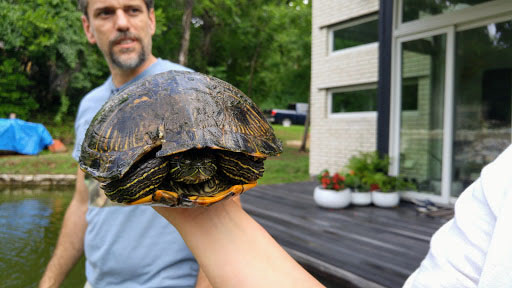
A few days after the visit, Viviana (the Wildlife Conservationist who originally tagged the turtle as being sick) found a vet and a wildlife rehabber willing to take a look at Craker’s unusual situation. Again, the humans of Spring Lake weren’t keen on messing with Mother Nature, but it was distressing to watch this creature suffer so much. If she couldn’t dive under the water, she couldn’t eat and she couldn’t protect herself from predators. So we did the sensible thing and loaded her into an igloo cooler, put lights atop our car* and drove her ambulance-style** to the vet.
*we did not really do this
**we didn’t really do this, either

Here are a couple of cool radiographs of her insides. Craker’s situation seemed to be a medical mystery. Was it a neurological issue? Did she have a virus? Was she exposed to harmful bacteria? The vet and the wildlife rehabber consulted experts in other states and together they all agreed on a trial treatment.


Craker’s Care Team had to make some tough decisions–such as force-feeding her. She was drastically underweight and they couldn’t get her to eat on her own. No one wants to force a metal tube down a turtle’s throat, but that’s what had to be done to give her a chance to live.
It’s not often one squeals in delight when a picture of turtle poop arrives via text message, but that’s exactly what happened on July 13. Seeing Craker’s insides starting to work again after so many weeks of stress was the cause of much celebration.
But she still wasn’t out of the woods. Getting nourishment in her was paramount in her recovery, but her buoyancy problem still needed to be fixed.

Now we’ll fast forward through the boring (but still important) parts of her rehab.
Over the next months, we received regular updates like this one:
She has taught us a lot, and the learning experience has been valuable for us and will benefit many future turtles. At least at this stage, she is comfortable and seems OK with the routine, so I don’t think the trial is causing her any undue stress.
Additionally, we received regular reminders that things were still very touch ‘n go for her. Craker’s Care Team wanted to make sure everyone understood that if Craker deteriorated they would do the right thing and humanely euthanize her. We made sure the children understood this too.
From the start, everyone involved believed Craker would “overwinter” with the vet. That meant a spring 2018 release if she survived.
But then something extraordinary happened. The wildlife rehabber reported that Craker started fighting the feeding tube. Her Care Team decided to stop feeding her to see if she would/could eat on her own. Seven excruciating days passed with nothing–then on the eighth day, she started eating with gusto! Her energy level went through the roof and she became difficult to handle. Her course of antibiotics was scheduled to be completed a few weeks later on August 24 and they found no reason to keep her in captivity after that. Everyone agreed it was best to release her back into the wild with the hope she would reacclimate to her surroundings before winter weather hit.
Craker was coming home after three full months of intensive treatment (and about six months earlier than we expected)!
The people of Spring Lake did what we do best–plan a party. We had cheese & crackers (with the extra c), turtle brownies, lots of bubbly, and a welcome home sign made by the girls of the neighborhood.
Craker returned to her home lake on September 4, 2017.
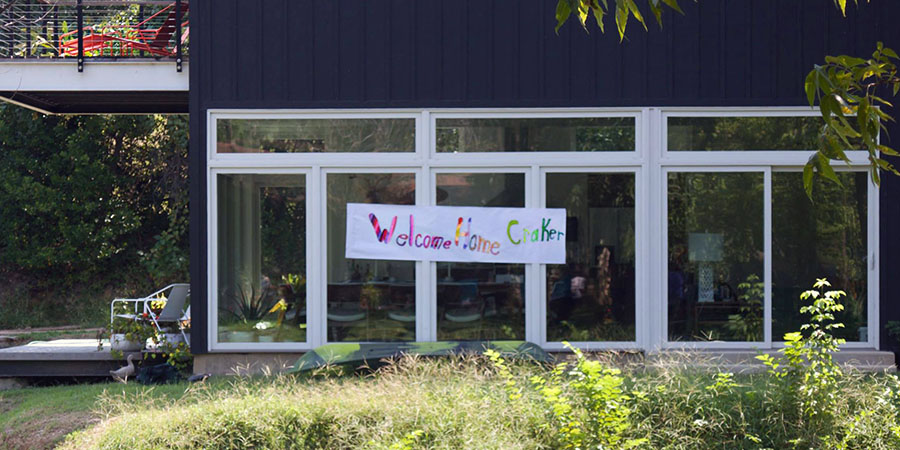
We learned from the rehabber that wild things are meant to stay wild, but human intervention is okay in some cases (always with a goal of putting the animal back into its proper home).

And we were warned that Craker’s health could still deteriorate. No one should be surprised if we found her floating again.
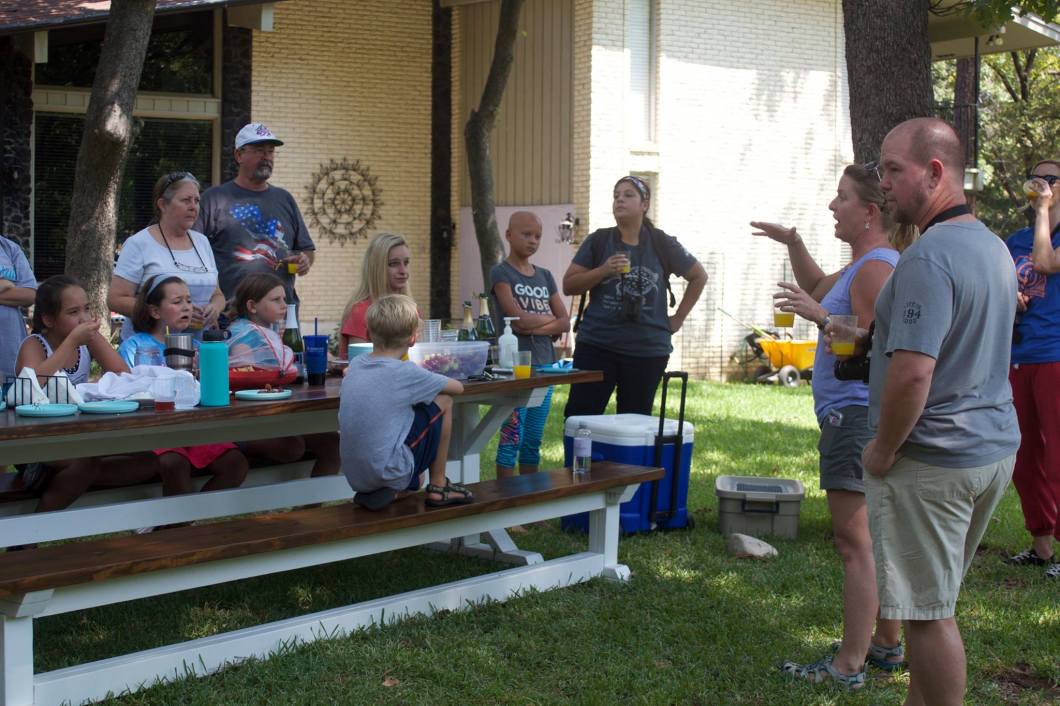
Even with all the cautionary talk of Craker possibly regressing, it was still a gloriously happy day. How often do you get to see–in person–a wild animal pull back from the brink of death?
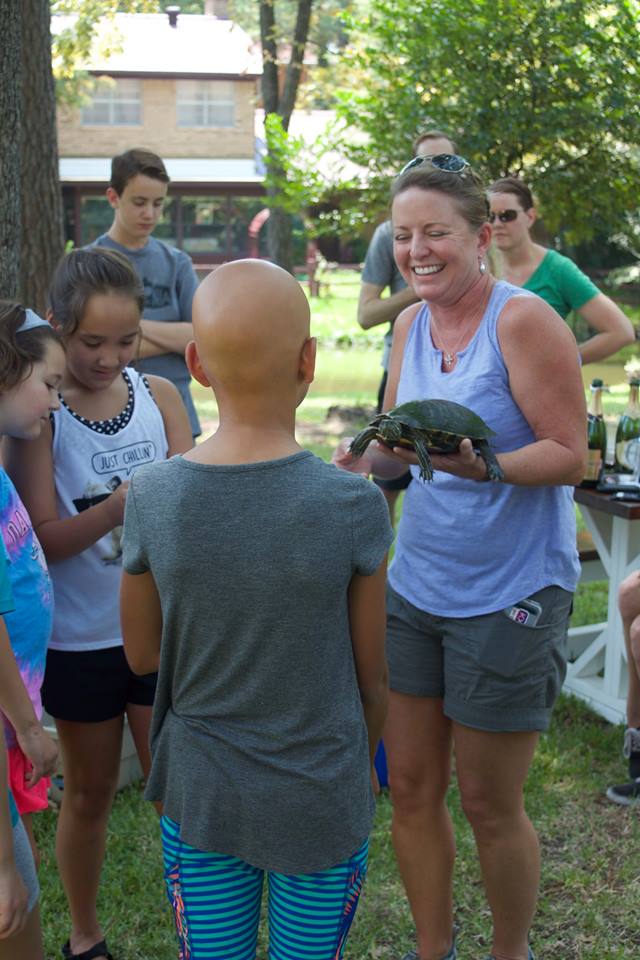
All the smiles!
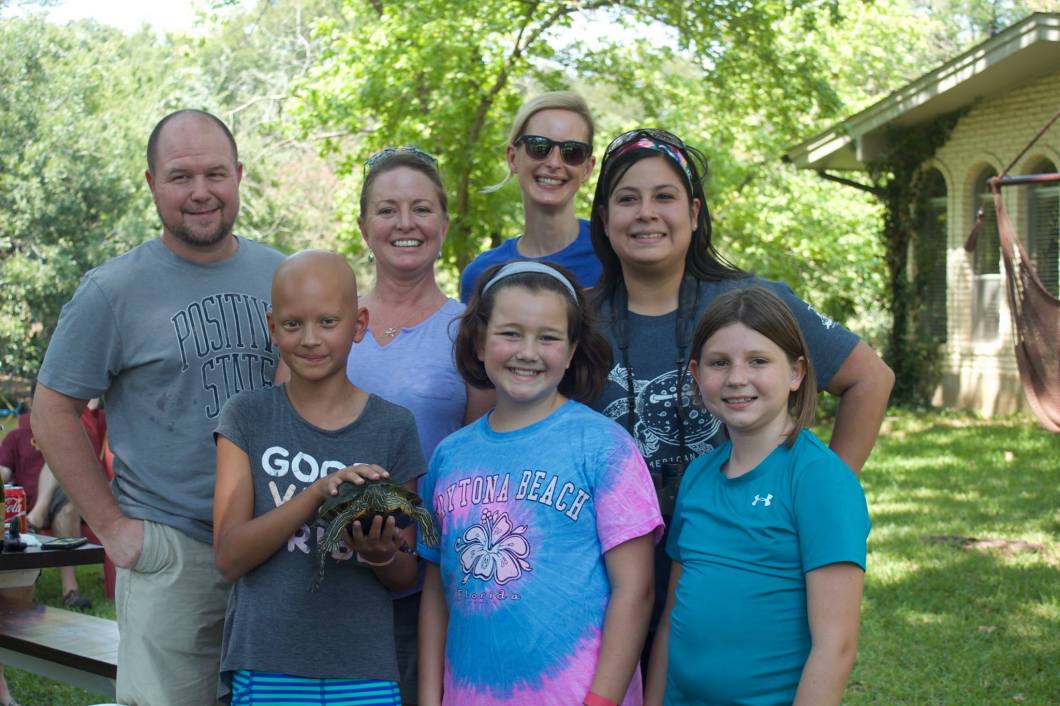
Craker was released near the same spot where the first picture in this post was taken. She scurried across the grass, slid effortlessly into the water, and stretched her legs by swimming on the surface for a bit. There was more than just a moment of panic when we realized she was still on the surface. Hearts sank. Her inability to dive in a natural habitat was our greatest fear. Then she looked back at the crowd and dove underwater with the grace of a competitive swimmer. A burst of cheering and applause probably startled the other wildlife. There were tears, too. Human tears. We’re not sure if turtles can cry.
As happy as we were that day, we still knew things were dicey. Would she be able to eat? Would her buoyancy problems return? Once again, we had to wait and watch. Mother Nature likes to teach us patience and this was a serious lesson. There were a couple of unconfirmed Craker sightings in late September and no sightings in October. We held on to the hope that she was still alive because the lake is small and we felt certain we would find her body if she died. We’re positive like that.
On November 5, she came out to say hi and let us know she was okay. Or maybe she came out to complain about the regatta we hosted that weekend. There were many screaming children and a lot of kayaks. It’s possible she wanted to file a complaint. Regardless of the reason for her appearance, we were thrilled to see her.
We don’t know what happened to her shell, but it’s fortuitous for us she has such a clear identifying mark.
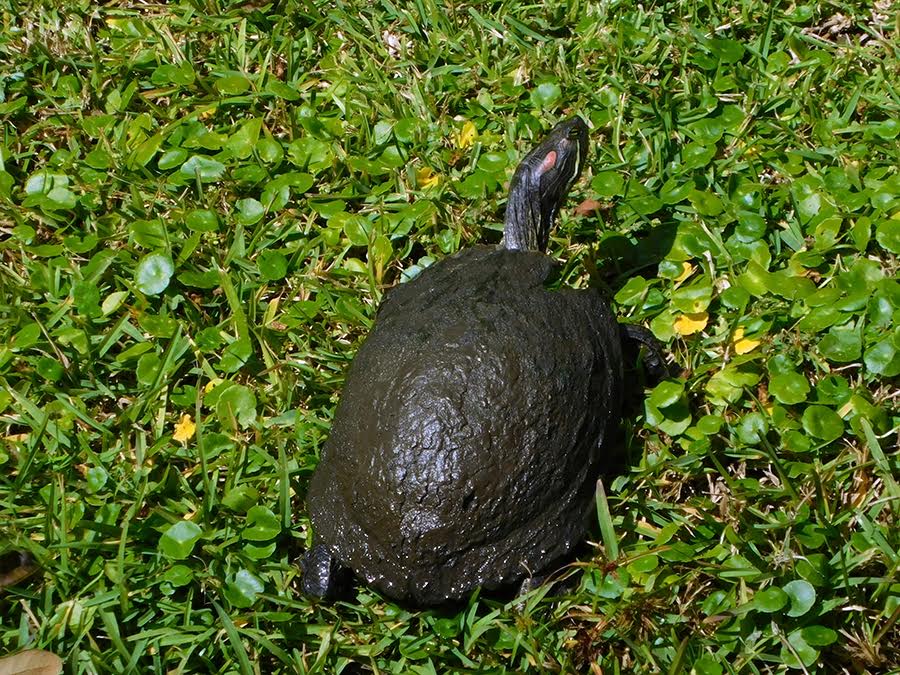
Then she made another appearance on November 12. This time she wasn’t out to complain to management. She was sunning herself and stretching her legs. You know, normal turtley things.
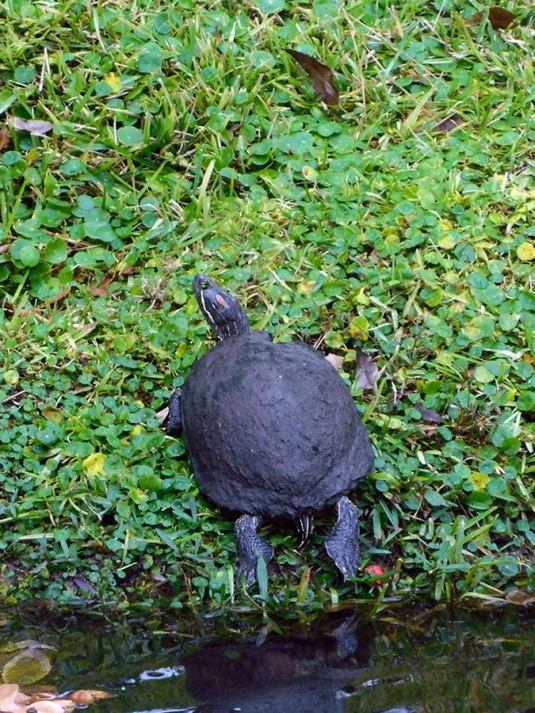
We don’t know what the future holds for Craker, but we know she has a good shot at a long and healthy life. This story would’ve been cool enough just ending there, but it goes on because the kids learned so much from this experience–and in Craker’s Care team they found mentors who will continue to shape their lives. They say good things come in small packages. Turns out good things can come from small, sick turtles too.
 Chronicles of the Spring Lake Adventure Club
[…] successful rehabilitation and convalescence showed us that the young people of the neighborhood were interested in learning more about their […]
LikeLike
[…] We tried narrowing it down to just a few of our core loves, but that didn’t feel right. After much discussion, we decided to focus on the one thing that started this adventure: Craker. […]
LikeLike
[…] club received the coolest gift from the vet team that rehabbed Craker! Katie Hulka read “A Mouse to be Free” as a child. She said it forever altered the way […]
LikeLike
[…] the beginning of the year, we had no idea 2017 would bring miracles, friendship, and adventure. Who knows what 2018 has in store for […]
LikeLike
[…] Ki miraculously caught Craker just using a minnow and her hands. We think Craker was hanging out on the surface of the water […]
LikeLike
[…] response to Viviana’s note, Katie Hulka (Craker Care Team member and SLAC mentor), wrote […]
LikeLike
[…] then it was just a matter of deciding which one to keep for the club and which one to give to Craker’s Care Team. This was a lengthy and intensely debated decision. There are subtle differences between the two […]
LikeLike
[…] then it was just a matter of deciding which one to keep for the club and which one to give to Craker’s Care Team. This was a lengthy and intensely debated decision. There are subtle differences between the two […]
LikeLike
[…] September 4, 2018, marked the one-year anniversary of Craker’s release after an intense rehabilitation with her Care Team. You can read all about it here: It started with a small, sick turtle… […]
LikeLike